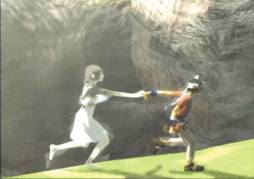
Ico is without a shadow of a doubt, one of the most impressive console releases
on any system this year from both a gameplay and an artistic stand. Ico blows
everything else out of the water with an aesthetic design that is nothing short
of breathtaking throughout. From a production standpoint, the title is
technically brilliant but, the real appeal of Ico lies in its unique gameplay
which is defiantly cerebral, yet incredibly evocative of another, mystical
world. Ico is most impressive for another reason: It’s the first game that
literally achieving the promises Sony made when it called the PS2’s graphics
chip an “Emotion Engine.”
Only
the hardest of hearts won’t find that there are many points in the game where
you’ll find yourself sympathizing with the characters, rooting for them to
succeed and feeling your heart in your throat when they are endangered. You can
literally feel your pulse quicken when Yorda is snatched away by a shadow
monster, and the desperation and sweaty palms that ensue as you try to rescue
her. This is all impressive enough from a plot standpoint when many titles have
the simplest, ineffective stories, but what’s even better is that Ico offers a
near flawless mix of tight action sequences and deeply engrossing puzzles making
an this an adventure game that represents the peak of gaming design and
structure on that succeeds on so many different levels, it’s nothing short of
astonishing. Ico’s
structure and approach is thoroughly original and innovative, unlike any
adventure title to date this game allows for a more contemplative, cerebral
approach than most other games. It’s plot unfolds at a dreamlike pace, slowly
revealing its mysteries to the player yet giving them more questions than
answers. It wouldn’t be fair to go into specifics, but there are certain
points where the cinema sequences leave you hanging by a thread with all sorts
of possibilities. While it might seem like it from the advertising, Ico isn’t
a traditional RPG by any means, so there’s no hit points or spells to worry
about which only enhances the realism.
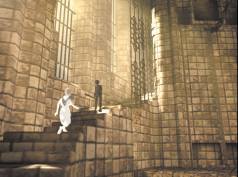 You
control Ico and have to help him escape from a dark castle where he’s been
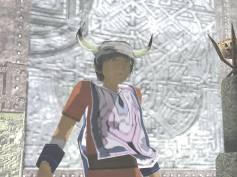
imprisoned by his village. He was born with horns and has been sacrificed, but
by a stroke of luck, a rumble sets him free from his prison and then his quest
begins. He sees a beautiful princess imprisoned in a cage and has to figure out
a way to free her. The main difference between this and all of the other games
in the genre, is that instead of just saving the princess Yorda passively by
beating enemies, you have an active role in helping her escape. On you free her,
she follows you around the levels and you have to move both her and Ico through
the levels. This is done by calling her or holding hands and running with her
through the levels. You
need to keep her at your side at all times since leaving her alone for any
period will cause the shadow monsters to try and grab her. Achieving this is a
lot harder than it sounds because of the complex levels which sometimes force
you to leave her alone. There are many ingenious, occasionally frustrating
puzzles in the game. In fact, it’s no exaggeration to say that Ico is
basically a large series of elaborate, intricate puzzles. In addition to
unlocking the mysterious puzzles and completing the various tasks, you also have
to watch out for the shadow monsters who are trying to capture Yorda. If they
succeed at pulling her into the portal, your quest ends. This isn’t a simple
as it sounds because the monsters are extremely aggressive and have a tendency
to gang up on Ico. Battling these enemies requires skill and persistence as
well, with multiple hits and many waves of them to face. Some of the battle
sequences can be quite strenuous, to the point of near tedium and while they get
on your nerves after awhile they do serve to break up what could have been a dry
and rather dull experience of box moving and switch pulling.
You
control Ico and have to help him escape from a dark castle where he’s been
imprisoned by his village. He was born with horns and has been sacrificed, but
by a stroke of luck, a rumble sets him free from his prison and then his quest
begins. He sees a beautiful princess imprisoned in a cage and has to figure out
a way to free her. The main difference between this and all of the other games
in the genre, is that instead of just saving the princess Yorda passively by
beating enemies, you have an active role in helping her escape. On you free her,
she follows you around the levels and you have to move both her and Ico through
the levels. This is done by calling her or holding hands and running with her
through the levels. You
need to keep her at your side at all times since leaving her alone for any
period will cause the shadow monsters to try and grab her. Achieving this is a
lot harder than it sounds because of the complex levels which sometimes force
you to leave her alone. There are many ingenious, occasionally frustrating
puzzles in the game. In fact, it’s no exaggeration to say that Ico is
basically a large series of elaborate, intricate puzzles. In addition to
unlocking the mysterious puzzles and completing the various tasks, you also have
to watch out for the shadow monsters who are trying to capture Yorda. If they
succeed at pulling her into the portal, your quest ends. This isn’t a simple
as it sounds because the monsters are extremely aggressive and have a tendency
to gang up on Ico. Battling these enemies requires skill and persistence as
well, with multiple hits and many waves of them to face. Some of the battle
sequences can be quite strenuous, to the point of near tedium and while they get
on your nerves after awhile they do serve to break up what could have been a dry
and rather dull experience of box moving and switch pulling.
What’s
so brilliant about Ico is its seamless integration of the puzzles and action
which makes it challenging intellectually and viscerally, giving even the best
players a good workout of both sides of their brains. Many of the puzzles are
incredibly complex and require multiple steps to complete which is great at some
points, but very frustrating because one small mistake and you need to go
through the entire sequence. Unfortunately there are more problems since Ico’s
more elaborate puzzles can get a bit oblique with shades of Myst. This makes it
very difficult to progress and you can find yourself seemingly stuck at certain
points. This can slow the pace down to a crawl as you backtrack frequently
looking for things and objects you may have missed. Some
less experienced players may need a strategy guide to progress, but proceed
carefully since the most satisfaction in the game is coming up with solutions
that may not be immediately obvious – looking at a solution in a strategy
guide should be treated as an occasionally necessary last resort. Fortunately,
Ico’s pace gets better once you know what clues to look for which can only
come by figuring out puzzles yourself. Even with familiarity with its
conventions, ICO is still not the easiest game to beat, it takes concentration
and determination – you shouldn’t expect to complete the game in one
sitting.
There
are a few reviewers
who have also complained of a seven hour completion time, but this is
misleading,
and reflects going through the entire game with a walkthrough or a strategy
guide. Of course, most players don’t cheat, and will thus spend a lot more
time than that just figuring out the puzzles. I personally have spent more than
12 hours on the game and I’m not even half-way through it. While the puzzles
can quickly become frustrating making the temptation of cheating very strong,
this should be resisted. While the puzzles seem difficult, this is mitigated to
a large degree by the numerous save points, which aren’t nearly as punitive as
they could have been. And, as always, the satisfaction of winning on your own
ability is the key to enjoying Ico, especially since its environment and
atmosphere are so unique and mesmerizing and not stopping to soak it in
short-changes the experience.
The
amazing graphics completely immerse the player into a richly detailed
environment, the screen shots just cannot do the game justice. Every element in
seems to fit together perfectly, giving the game a solid foundation of realism
and scale that can be breathtaking or terrifying. This is especially true when
you see Ico’s small frame dangling over a massive expanse of space. The
sense of epic scale and proportion is simply astonishing with the architectural
accuracy of the castle combining with beautiful lighting effects to make this
one of the most visually impressive games ever seen.
What’s impressive about this is that the environments aren’t static
either, they are all fully 3D and interactive, making the world in Ico feel very
much alive. Ico’s character animations give Ico and Yorda highly-developed
believable personalities that the player can really relate to – you can tell
immediately that Ico is a young boy with an awkward, yet noble appearance, while
Yorda’s ghost-like appearance lets her radiate a sense of mystery,
vulnerability and sadness that makes it impossible to not want to help her
escape from the castle.
Even
cooler are the shadow monsters, who seem to emerge from out of nowhere, which
blue, piercing eyes that radiate a constant sense of menace and determination on
their part. The monsters’ animations are beautiful and eerie, they seem to
flow through the floors and levels like black liquid, not so much moving as
flowing through the scenery as they relentlessly seek to capture and pull Yorda
back into the dark world. These adversaries ooze malice and terror as they
attack relentlessly. They are a terrifying presence in the desolate castle since
they both attack in groups while dwarfing Ico in size and power, further giving
the player a sense of the young boy’s desperation and determination in his
quest. The animation is really impressive and fluid throughout, giving the game
a sense of life that few others have ever come close to achieving. Whether in
Ico’s awkward steps and Yorda’s nervous jumps over large gaps, or the way
that Ico extends his hand to catch her after a jump, the animation conveys a
sense of real people in real space.
What’s
also impressive about Ico’s aesthetic approach, and one of the elements that
really sets it
apart from the pack is the game’s intelligent use of sound. Notice the
emphasis on sound this is because there’s virtually no music in the game but
there is plenty of ambient sounds, such as birds chirping or water falling in
the background. Though for long stretches of the game, there’s mainly silence,
with only the sounds of your footsteps to keep you company. This gives Ico a
real sense of existing in a real world, making for a surprisingly subtle
experience. While it’s easy to praise the obvious, Ico’s subtle brilliance
is much harder to pinpoint. The restraint that the designers have shown in this
area of the game is impressive helps to heighten the sense of dark, loneliness
of the castle. This makes the environment seem even more alive and shows how
much thought and care goes into making a title that transcends the normal
expectations and sets up parameters entirely of its own making.
 Ico
features a surprisingly coherent camera system that works nearly seamlessly with
the controls to create a seamless, virtually transparent interface. It’s one
of the best for a 3D environmental title that I’ve come across and is
basically another element where the intelligent design of the entire game
shines. Either in long-range mode or extremely close-in when performing
intricate tasks, the camera is very sophisticated and enhances the overall
experience instead of hindering it. Where many games stumble badly by blocking
your view at crucial points, or giving you an awkward angle, Ico has virtually
no points where the camera impedes progress and most of the time, the angles
switch in such a way to make things easier. Moving and jumping is simple, and
using the back shift key to call Yorda is quite effective. The game uses both
analog and digital pads and it’s a good idea to master Ico’s controls and
movements early on, since there’s much less room for error on the later
levels. This helps the game flow and move at a good pace and allows the player
to have a good viewpoint of the entire environment. With such an elaborate
system, looking around is an essential skill to learn and luckily it’s easily
accomplished. Adding to Ico’s atmosphere, its plot seems to drift slowly like
a dream, slowly and deliberately revealing mysteries yet withholding enough to
keep you intrigued throughout.
Ico
features a surprisingly coherent camera system that works nearly seamlessly with
the controls to create a seamless, virtually transparent interface. It’s one
of the best for a 3D environmental title that I’ve come across and is
basically another element where the intelligent design of the entire game
shines. Either in long-range mode or extremely close-in when performing
intricate tasks, the camera is very sophisticated and enhances the overall
experience instead of hindering it. Where many games stumble badly by blocking
your view at crucial points, or giving you an awkward angle, Ico has virtually
no points where the camera impedes progress and most of the time, the angles
switch in such a way to make things easier. Moving and jumping is simple, and
using the back shift key to call Yorda is quite effective. The game uses both
analog and digital pads and it’s a good idea to master Ico’s controls and
movements early on, since there’s much less room for error on the later
levels. This helps the game flow and move at a good pace and allows the player
to have a good viewpoint of the entire environment. With such an elaborate
system, looking around is an essential skill to learn and luckily it’s easily
accomplished. Adding to Ico’s atmosphere, its plot seems to drift slowly like
a dream, slowly and deliberately revealing mysteries yet withholding enough to
keep you intrigued throughout.
Ico
is absolutely a classic that has stood the test of time. It's
an exceptional game that transcends genres and should be experienced by all
gamers. Ico is the result of creativity, innovation, spirit and a pureness that
doesn't happen often these days. Rarer still is the game that
delivers something extraordinary, with very few missteps along the way. While
the puzzles can be a bit frustrating and the battles with the shadow monsters
can get tedious, these are very, very minor blemishes on what is one of the most
incredible adventure titles ever made. Ico’s outstanding, evocative production
design is unparalleled with many breathtaking sequences, specifically one
involving a huge windmill, that are astonishing by any measure. With near
flawless, richly detailed environments, an incredible artistic vision,
uncompromising gameplay and almost-perfect execution, Ico is a landmark title
that sets new standards in almost every area. Ico comes as close to perfection
as any adventure to date, and is about as close to a masterpiece as has ever
been released on any platform.
- Michael Palisano